





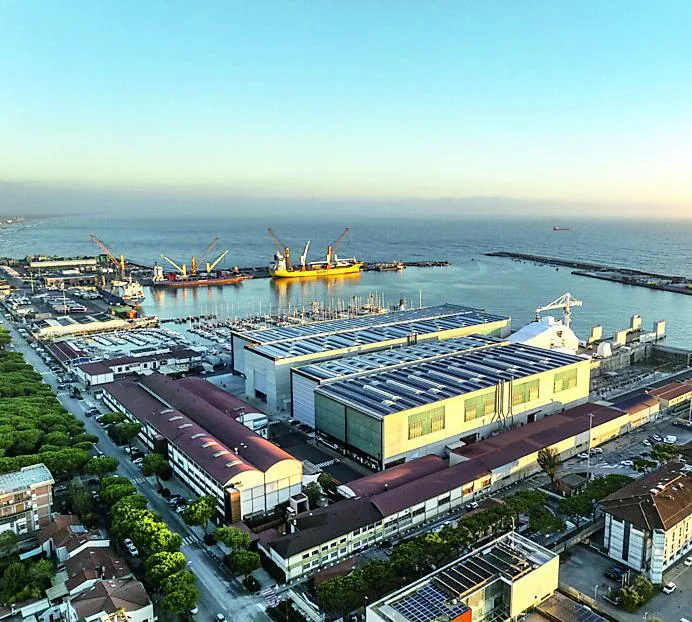
CARRARA. A “white knight” is being sought for The Italian Sea Group, the large shipyard overlooking the port of Marina di Carrara from which luxury yachts up to 140 meters long set sail. The shipyard, which designs and builds sea locomotives with internationally prestigious brands such as Admiral, for example, or Perini Navi—creator of the iconic Maltese Falcon—has been in crisis for five months.
Read more Fedez urgently hospitalized
It is a liquidity hemorrhage: the social capital has dropped from 26.5 million euros below the minimum allowed threshold of 50 thousand euros. The creator and helmsman exits the scene – this was news yesterday: Giovanni Costantino, co-founder of Tisg and CEO, and also chairman of the board since the crisis emerged: he takes with him his son Gianmaria, a board member. Costantino has resigned from his position as company director; the decision is based on the intention to facilitate the restructuring process of Tisg with a change in governance and to increase the confidence of external observers.
As of the date of his step back, Costantino holds, through Gc Holding spa, a company he controls, a 53.6 percent stake in the company’s share capital, or 28,410,000 ordinary shares.
The discovery
It is the beginning of the year when signs of a possible collapse of Tisg, a company listed on Euronext Milan, emerge. In February it becomes clear that extra budgets, unplanned additional costs on ongoing contracts, are out of control. It is a tsunami. First: because of the feared repercussions on employment, and the union representatives of Fiom, Fim, and Uilm raise shields; direct employees were 530 before the earthquake and the induced jobs are more than a thousand, with talk of 1,200/1,500 workers employed by companies (micro, mini, small, and medium-sized), some of which work for Tisg under a single-client regime. Complicating the picture is the way the course was lost, leading to the shipwreck.
Measures are taken
The company’s top management censures the conduct of some managers: they are called “disloyal.” They are fired, accused of not revealing that the shipyard was running out of oxygen. They are expelled and sued. Costantino proceeds with a reinforcing injection of 25 million euros. And a total reorganization plan of the shipyard that includes renegotiating orders with shipowners; he has identified a new team of managers and consultants who will support him to get the convoy back on track. He announces recourse to negotiated composition.
Read more Eu-Ets Review, Alis satisfied (but not too much)
Protection
On July 1st, Tisg filed with the Florence Court the application to access a crisis regulation procedure provided for by article 44 of the Business Crisis and Insolvency Code, which today governs the old preventive arrangement in blank. On July 3rd, the Court appointed the judicial commissioners: Professor Niccolò Abriani, lawyer, Riccardo Forgeschi, and Manuela Olastri. Tisg’s management commented: “The Court noted that the crisis regulation project is coherently structured with a view to business continuity.”
Scenarios
Moving forward “in continuity” means there are no obstacles to continuing business activities: designing and producing yachts; however, this does not exclude the arrival of a White Knight (person or company), the only card that seems left in the deck if one wants to look to the future. So, here is what could be along the road to saving the luxury yacht shipyard: a buyer who temporarily leases the company; or a taker (of assets and liabilities) who commits to paying creditors in certain percentages, taking over ownership of the company; or, again, an investor who subscribes to a capital increase of the debtor company becoming the owner and paying creditors proportionally.
Hypotheses and names in the field
To date, there is talk of three/four international-level investor entities who would be looking at the shipyard through binoculars; some would already have interests in the yacht sector: stepping forward would be a choice perfectly consistent with their business, a sort of completion. On the sidelines of a meeting on the Tisg crisis held yesterday in Florence within the Tuscany Region – attended by the mayor of Carrara Serena Arrighi, the union representatives but not the company’s top management who were not summoned – two names emerge that were already circulating: the historic shipyards Sanlorenzo and Lürssen, an icon of Made in Germany yachts. It remains to be seen whether these are just wishes and/or hopes of those watching the staggering giant Tisg or if there are really tangible elements to hit the target.
The workers’ front
Meanwhile, the union is concerned both about the phenomenon of voluntary resignations by Tisg’s direct employees – which have fallen below 500 since the beginning of the crisis – and the failure of Inps to grant wage supplementation to at least four companies working for the shipyard, two of which are single-client, all (and they are not the only ones) stalled due to uncovered invoices and the drop in work coming from the shipyard.
Read more Inps, income-linked pensions: who is at risk and how to avoid revocation (by September 15)