







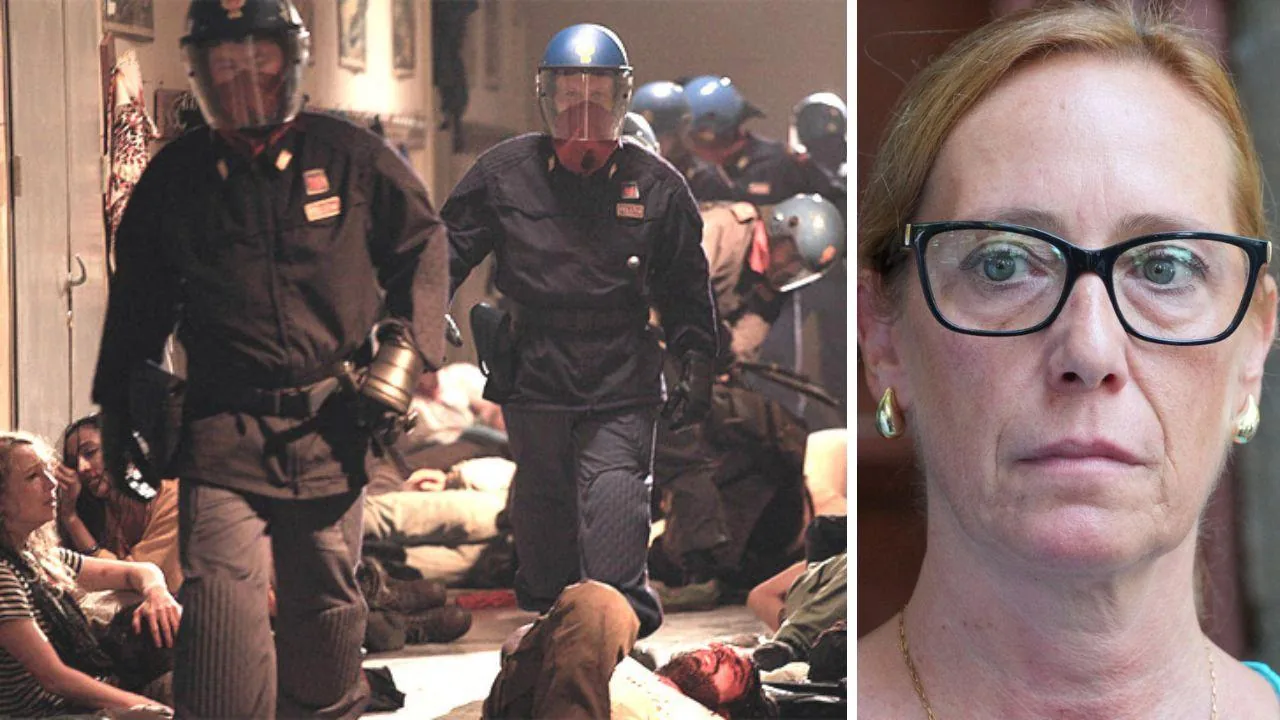
July 20, 2001. 25 years ago. The afternoon when the State consciously decided to close its eyes. These were the days of the G8 in Genoa, the summit of the leaders of the eight most industrialized nations in the world, which coincided with one of the darkest and most dramatic pages in the history of the Italian Republic. During the street riots, the twenty-three-year-old protester Carlo Giuliani was killed by a gunshot fired by a carabiniere. Added to this were the “Mexican slaughter” at the Diaz school, the nighttime police raid that turned into a massive indiscriminate beating of activists and journalists, and the horrors of the Bolzaneto barracks, the temporary detention center where hundreds of arrested protesters were taken and where they suffered physical, psychological abuse and torture. Overall, it was a long and horrible parenthesis of suspension of democratic rights. Like the one experienced a few years later (in October 2009), firsthand, by poor Stefano Cucchi and subsequently endured for a long time by his sister Ilaria, now a senator of the Republic.
Read more The candidate must be able to
know the salary
before the interview
Senator Cucchi, what do you remember about that day in Genoa and what was your reaction?
«I was a very different person from who I am today. But I was shocked, because even in that case, as happened some years later with my brother, there was a total denial of the evidence combined with the criminalization of the victim. Fortunately, there was an immediate great mobilization, which then allowed us to forever carry the G8 in our hearts and in our history. 25 years later, however, we are still at the G8 in Genoa. Nothing has changed. In fact, in some ways, we have even taken steps backward. And so thinking that the sacrifice of Carlo and his family was for nothing gives an idea of how small our country is and how incapable we are of evolving and how little we have the ability to learn from what we live through and what has happened. So let’s not just fiddle on social media, let’s inform ourselves properly, read the newspapers, not get lazy and not let ourselves be brainwashed. And above all, let’s not stop being outraged. When we hear about a kid beaten at a protest or a girl mistreated in a police station, let’s not turn the other way, let’s not pretend nothing happened, because in that way, even unknowingly, we are justifying those acts, we are legitimizing them. That would be the biggest mistake we could make.»
The so-called “criminal shield” for the police forces, introduced in the Security decree, provides that for acts committed during service the public prosecutor may not automatically register the officer in the register of suspects. The registration is replaced by a preliminary note if the crime appears to have been committed in the presence of a justification cause, such as self-defense. What do you think about this?
«They are not even able to write laws properly. Don’t they know, for example, that being registered in the register of suspects is a way to be more protected? I don’t understand the rationale of this provision. I wonder what it could serve if not to legitimize and further promote corporatism. At this moment, I don’t think the primary need of the police forces is to have the criminal shield. Are we perhaps saying that they are all thugs and need the criminal shield? Italians certainly don’t think so. But it is also true that on the other side, penalties for protesters are increased and so it will happen that during protest events the protester who will be beaten will have no power. Is this thought to be good for the police forces? I really don’t think so, because ordinary citizens, especially the so-called last ones, do not have the capacity, especially economic, to sustain long and costly trials, especially those against abuses in uniform. Why do we want to further increase the gap between the people and the powers?»
Let’s come to your personal story and that of your family. How much do you still miss Stefano?
Read more Last minute subscription from 200 euros and the request to pay 700 in installments
«When you live situations like mine, when you live years and years of trials, somehow we are not allowed to process the grief, and so it’s as if Stefano were still with me. And he is also because I was not allowed to let him go. Because there was no time to cry, because an instant after his death I understood that I would have to use all my energy, put aside the pain, the suffering and the need, precisely, to process the grief, to be able to move forward taking on what should have become a real battle. Not only in the courtrooms, but also among the people. By now we know how dangerous social media can be, through which everyone feels entitled to say anything. I have taken many insults and I still take just as many. I have grown thick skin but at the beginning it was extremely complicated, especially defending, in the collective imagination, the figure of my brother, who obviously could not defend himself because he was beaten to death. I remember how many times it was necessary to publicly show that photo of Stefano dead and battered in body and face to prove that he did not die because he was a junkie or because he fell down the stairs. Despite evidence acquired for years, horrible comments still come today, “But what do you want? Your brother was just a shitty junkie,” is just one of the most recurring. An attitude that unfortunately spilled over into the courtrooms, as throughout the first trial, which I call the wrong trial because there were the wrong defendants who should have been the witnesses, the wrong charges and the witnesses who were the real culprits and who therefore should have sat on the defendants’ bench. It was a trial against Stefano Cucchi, not against those who killed him. Everything was said about Stefano: about his thinness, his character, his family relationships and the fact that we family members had abandoned him. Our lawyer, Fabio Anselmo, whom I later fell in love with and with whom there is now a beautiful love story, was a hero, always holding on and moving forward despite all the hypocrisy heard. It was a trial in which it was not possible to talk about the beating and the responsibilities of the carabinieri. Returning to the question, I miss Stefano very much, but it is also true that I still carry him inside me in all the battles I fight. I was at a crossroads, I could have made two choices: the first, to move on with my life and avoid here trials and those years of pain for my parents (for everything they had to hear about their son both got sick and then died), staying home to raise my children and avoid fighting a battle that seemed much bigger than me, because it is terrible when the State becomes your worst enemy. In this case, however, perhaps I would have become bitter, I would have lived in anger. The other choice, which fortunately I made, was the wiser one: to transform that pain into something positive, perhaps less useless and less self-serving, making that experience so deeply intimate and personal into a public affair. And so the famous “Cucchi Case” was born.»
Have there ever been moments when you thought you would never manage to bring out the truth?
«To be honest I always knew that the truth, sooner or later, would come out. As I have always been convinced that the responsible were the carabinieri and not those poor three prison police officers who went through years of trials as innocents and who have aged with me. There have been many difficult moments. Paradoxically, what should have been the worst moment of all, October 30, 2014, when the acquittal sentence was pronounced for all defendants, turned into the day of the decisive and positive turning point. The formula of the sentence said in fact that the responsibilities had to be sought elsewhere. A huge satisfaction, because after five years from Stefano’s death it was no longer said that my brother died of natural causes and the beating was recognized. And not only that, the failure of the State was recognized, which in all those years had not been able to identify the responsible. What could have been interpreted as a definitive defeat, for me was a great victory to start again stronger than before.»
You are frequently a guest at schools for debate initiatives with students. Are you able to highlight to them the importance of respect towards institutions and the State?
«Yes, I can. It is the first thing I always think about, on every occasion. Perhaps the second, to be honest, after reminding them that Stefano Cucchi was not a hero or an example to follow. Talking with young people is indeed a very important and at the same time very delicate task. I tell them that institutions must be respected and I also say that I would like to be an example of tenacity, of courage for them. But above all because for years I have gone to courtrooms to challenge institutions in respect of those same institutions. Because it is only in this way that things can be changed.»
Read more International justice exists, but its effectiveness depends greatly on States
© RIPRODUCTION RESERVED


