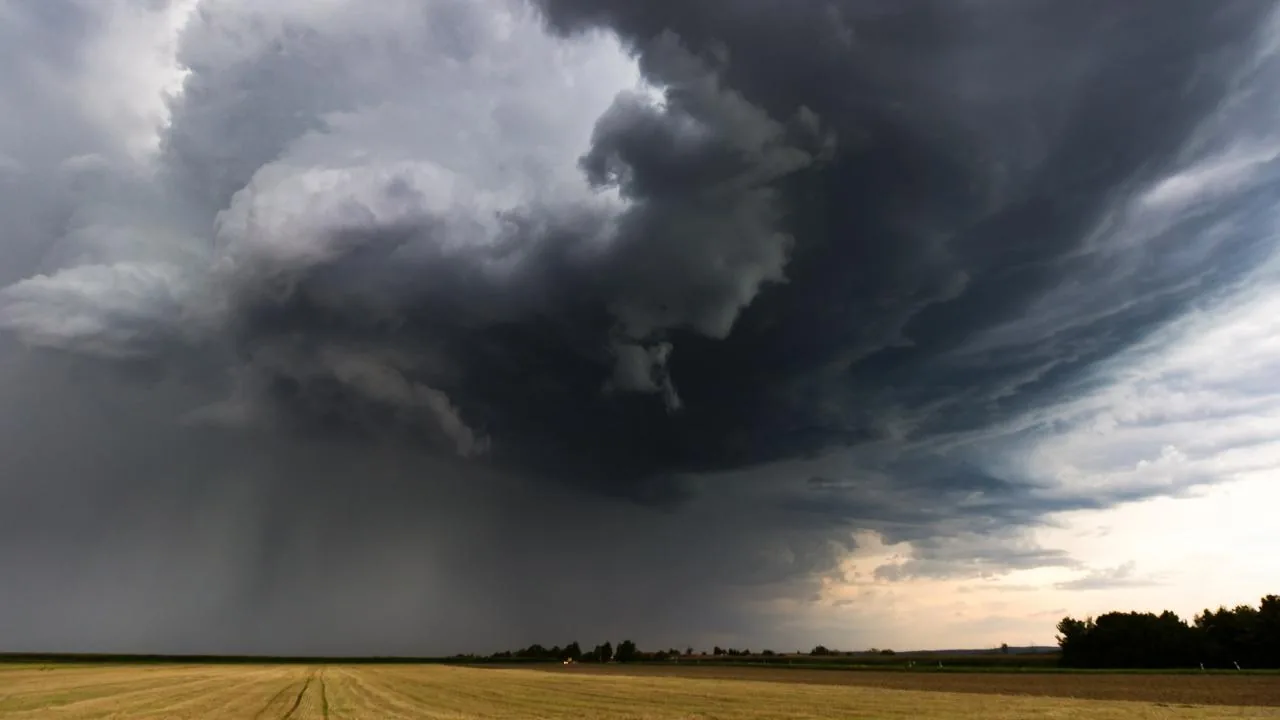




The damage was considerable. Flooding, hailstorms, gusts of wind. But the wave of bad weather on Thursday, September 10 in Tuscany also brought a genuine tornado. Which also caused a fatality. The day after the storms and extreme phenomena, a detailed report arrives on what happened in a specific area of Tuscany. In Sinalunga, in the province of Siena. Where in an instant, on the afternoon of Thursday, September 10, hell truly broke loose. But let’s go in order.
Read more Boarding tax, “assist” from the Council of State to port municipalities
In the grip of bad weather
Gusts of wind, heavy rains, and extreme phenomena – as mentioned earlier – hit various areas of Tuscany on September 10. Among these was the Valdichiana, where Sinalunga experienced one of the most dramatic moments in its recent history: a violent windstorm caused the death of Giuliana Cassioli, 82 years old, caught by the worsening weather while she was in her home. According to the reconstruction, the woman had approached the window to close the shutters in an attempt to protect the house from the wind. In those minutes, the fury of the gusts violently slammed the shutter against the glass: a fragment, forcefully detached, hit her leg severing a vein. The blood loss was very rapid and, despite the arrival of emergency services alerted by her daughter, nothing could be done. The community is shocked. “Roofs can be repaired, cars can be fixed, but what happened to the lady is not right,” residents repeat, still incredulous in front of an event that left uprooted trees, torn-down streetlights, shattered windows, and damaged houses behind. Fifteen minutes of devastation.
Analysis by Centro Meteo Toscana: “Not a downburst, but an F1 tornado”
On Friday, September 11, the Centro Meteo Toscana analyzed images, radar data, and testimonies collected in the area. The conclusion is clear: what hit Sinalunga was not a downburst, but a tornado classified as F1. An assessment that completely changes the interpretation of the event. The Cmt explains that this is a rare phenomenon for Tuscany, but no longer as exceptional as it once was: “The episode confirms the increasing extremity of atmospheric phenomena in our region,” the Cmt emphasizes. The tornado traveled a short distance but with enough power to cause significant damage. Centro Meteo Toscana also recalls that Estofex, the European service monitoring severe phenomena, had issued a level 3 alert for the day: a signal that increasingly often anticipates episodes of strong impact.
How tornado strength is classified
Tornado classification is not based on direct wind measurement – which in most cases is impossible – but on the analysis of the damage caused by the vortex. This is the principle behind the Fujita scale, introduced in 1971 by meteorologist Tetsuya Theodore Fujita and today used in the updated version Enhanced Fujita (EF) in the United States and many Western countries. According to guidelines from the National Weather Service and NOAA, experts evaluate a series of “damage indicators” (Damage Indicators, DI) such as houses, trees, agricultural structures, towers, vehicles, and infrastructure. For each indicator, the degree of destruction (Degree of Damage, DoD) is estimated, which allows deriving an estimated wind speed and thus the tornado category. In the traditional classification, an F1 tornado – like the one in Sinalunga, which was captured in all its power also by some citizens and motorists who witnessed its passage – is associated with moderate damage: partially torn-off roofs, broken trees, overturned caravans, damaged light structures. The categories increase up to F5, which represents catastrophic destruction with buildings completely leveled and heavy objects thrown great distances. The logic is always the same: the wind is not measured, what the wind did is measured. It is an internationally recognized method because it allows classifying tornadoes that were not directly observed or recorded by instruments.
Downburst and tornado: what really distinguishes them
According to guidelines from the National Weather Service and NOAA, the difference between tornado and downburst mainly concerns wind dynamics. A tornado is a rotating vortex descending from the base of a thunderstorm and touching the ground, generating a concentric circulation that causes damage along a narrow and defined path. A downburst, on the other hand, is the opposite: there is no rotation, but a column of cold air that falls toward the ground and spreads in all directions once it hits the surface. This causes radial damage, often more extensive but with a completely different pattern. In summary: the tornado “sucks and rotates,” the downburst “falls and spreads like a fan.” For this reason, experts analyze the orientation of fallen trees, the direction of debris, and the distribution of damage to determine which of the two phenomena occurred.
One victim and a wounded city
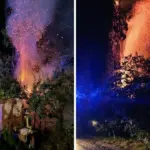
The death of Giuliana Cassioli is the most tragic toll of this wave of bad weather in Tuscany. Her daughter, who arrived to check that her mother was well, found her already lifeless. A scene that deeply shook the entire community, including Mayor Edo Zacchei, who knew the woman and spoke of an “absurd and sudden event, difficult to accept.” Meanwhile, Sinalunga counts the damage: torn-off roofs, fallen trees, damaged public structures. Images circulated on the web clearly show the violence of the vortex that crossed the city.
A sign of the new climate normality
The Sinalunga tornado fits into a broader picture: the series of extreme phenomena that in recent years have been affecting Tuscany, from sudden bad weather to violent hailstorms, up to storm winds hitting areas usually less exposed. Centro Meteo Toscana reiterates that episodes like this, although rare, can no longer be considered isolated exceptions. The warmer atmosphere, high humidity, and favorable dynamic conditions can generate vortices even in areas where they were once almost unthinkable.
A community trying to restart
While technical checks and damage assessments continue, Sinalunga rallies around Giuliana’s family. The tragedy has left a deep mark, turning a meteorological event into a human wound difficult to heal. The city, however, is trying to get back on its feet. Restoration work has already begun and local institutions are monitoring the situation to ensure safety and assistance to residents.
Read more Emma Bonino has died: «A life of battles for rights»