







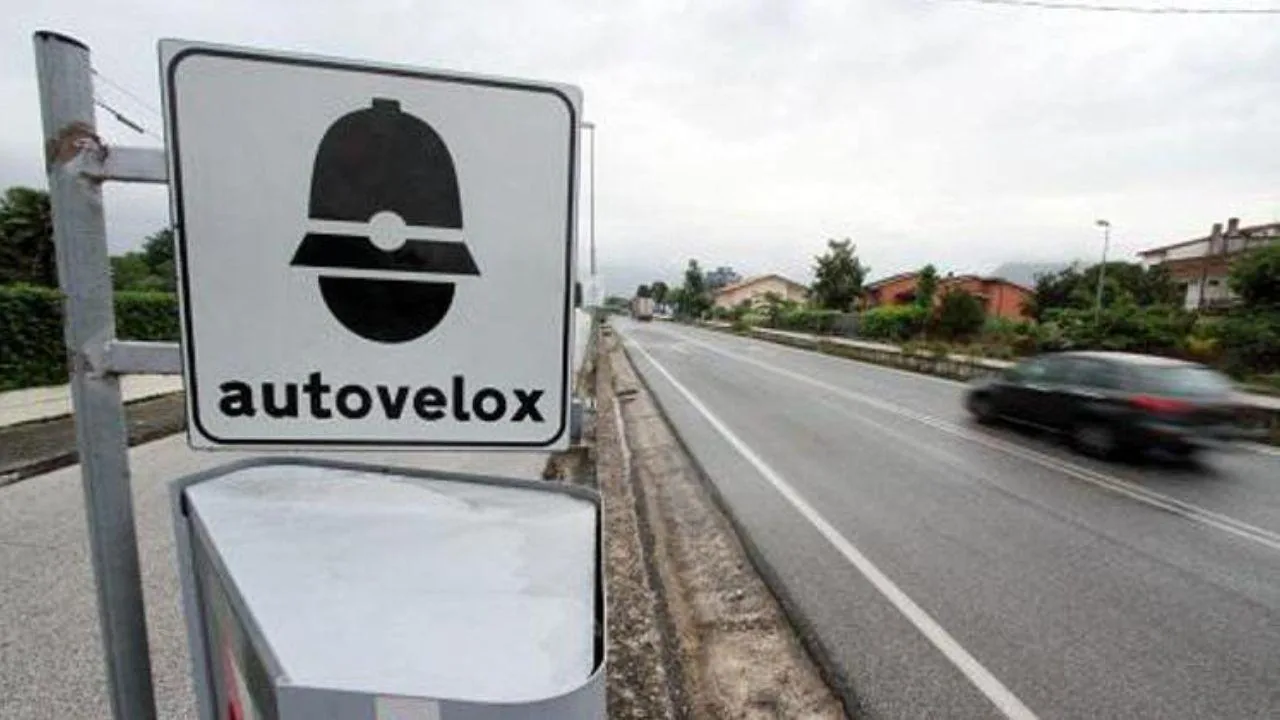
It is not a jungle, but a maze of paper and bureaucracy where road safety seems to get lost in a political and propagandistic mess. The much-touted Autovelox decree, published on July 11, 2026, presents itself as the ultimate weapon against the “ticket chaos,” but looking closely, among the pixels of Tuscan cameras and the paragraphs of ministerial decrees, it resembles yet another Italian-style mess.
Read more Superenalotto, today’s winning numbers July 14 – Jackpot of 193.6 million euros
The date and the numbers
The starting point is a clear snapshot of Tuscany: there are 143 speed control devices approved with decrees prior to June 13, 2017. The date is not a detail, but the legal watershed set by the Ministry of Infrastructure and Transport. For these 143 “veterans” of the road, the path to compliance is all uphill: the manufacturer will have to face the entire, complex approval process required by the new technical standards.
However, there is a second category of devices: about 122 other devices that are “remediable” with relative ease, as they were approved after that fateful 2017 date. For these, the new regulation provides a sort of fast lane, a simplified procedure that requires a simple application to transform the old “approval” into a brand-new “homologation.”
The expert speaks
Precisely on this point, Sergio Bedessi, an expert in municipal police and president of Cedus, does not spare criticism, calling the operation “an amnesty.” According to the expert, the decree does not solve the Gordian knot that has paralyzed municipalities for years: the legislative confusion between homologation (based on predefined technical rules) and approval (a simple functionality check). “The risk is that litigation will not decrease, but actually increase,” he warns, emphasizing how there is an attempt to remedy “with an administrative act (the ministerial decree, ed.) an anomaly that resides in the primary law, namely the Highway Code.”
Criticism of the decree moves along the lines of political communication and technical consistency. On one side is the narrative of Minister Matteo Salvini, who spoke of a “jungle of 10,000 speed cameras” to be thinned out, when the official census counted just 4,060 across the country. A number, according to Bedessi, artificially inflated: “It’s pure populism. He played on the fact that people rightly hate getting tickets, but these are bar talk.”
Read more Milka chocolate snack withdrawn from supermarkets: the affected product
On the other side is the technical mystery of the “Tris” platform. The text of the decree published in the Official Gazette is in fact different from the one sent to Brussels for the mandatory notification to the European Union. Among the most striking changes is the disappearance of the rule that provided for the immediate “shutdown” of non-compliant devices. “In reality, nothing has been ‘turned off,’ reasonably I should turn them all off until I have the first homologations. But that’s not the case,” explains Bedessi.
Where the European drafts spoke of some laboratory tests that “must” be carried out, the final text uses a more permissive “may,” leaving worrying margins of discretion. “Moreover, where laboratory tests cannot be performed with standard means, the possibility is hinted that manufacturers themselves can choose the methods. It’s like letting everyone loose,” comments Bedessi
In detail
Going into the details of the Tuscan geography of speed cameras, the 143 regional devices approved before 2017 are distributed extensively across all provinces, with significant concentrations in provinces such as Florence, Lucca, Pisa, Livorno, and Grosseto. However, Bedessi points out that many of these numbers describe a reality made up of outdated technologies and devices that could be turned off.
Alongside these, the 122 instruments approved after the 2017 watershed will benefit from a simplified homologation procedure. It can be assumed that they will remain active, but it will be necessary to see how many will be remedied within the expected timeframes. Each speed camera will need to be analyzed case by case, verifying technical documentation, approval measures, and compliance with the new rules. Only after these checks can it be established which devices can continue to be used immediately and which will have to complete the new procedure provided by the decree.
The complete list
- Local Police not localized (3)
- Not localized (1)