



The two-month period June-July 2026 was the second hottest in Tuscany since the beginning of historical series recordings in 1955, with a regional average temperature of 25.6 °C, second only to 2003 (26.2 °C). In Florence, during the same period, maximum temperatures exceeded 36 °C on 27 days, a record in the Lamma historical series: practically one day out of two. There were also 27 tropical nights, with minimum temperatures not below 20 °C. Only 2003 recorded more, with 30.
Read more Lotto, in Tuscany a hat-trick of almost 400 thousand euros
These are some of the data provided on August 3 by Lamma, the Laboratory for Environmental Monitoring and Modeling for sustainable development, during the press conference held today at the Laboratory headquarters in via Madonna del Piano 10 in Sesto Fiorentino, attended by the President of the Tuscany Region Eugenio Giani, David Barontini, Regional Environment Councillor of Tuscany, Regional Councillor Luca Rossi Romanelli, Beniamino Gioli, director of the Institute for Bioeconomy of the CNR, and Francesco Meneguzzo, extraordinary commissioner of the Lamma Consortium.
According to the update of July 31 released by Lamma, the subtropical anticyclone will continue to prevail at least until Saturday, August 8, with maximum temperatures between 38 and 40 °C in the internal areas of Tuscany and minimum temperatures widely above 20 °C. The hot phase, estimated overall at 11-12 days, should ease around August 9-10. The next updates will define how marked and lasting the pause will be and whether new hot phases will follow.
«The Lamma Consortium – explains the President of the Region, Eugenio Giani – not only has a forecasting role but also provides guidance on how to operate to protect work, health, and the environment. At the beginning of September, the Council intends to present a law on green regeneration aimed at investments to get cities out of the heat island effect with new tree plantings and greenery, new environments that from an environmental point of view can lower temperatures which today are exacerbated by concrete, asphalt, and excessive urban concentration. The Region also intends to increase projects that already see it at the forefront nationally: the creation of lakes, reservoirs, and water bodies to face drought periods. Tuscany can today count on the 67 million cubic meters of water contained in the Bilancino reservoir and the 135 million cubic meters of water retained by Montedoglio».
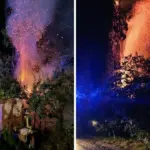
«We are thinking – continues Giani – of a series of interventions that can provide water in a capillary and widespread way. Here the importance of having inaugurated in June 2025 the small lake one and a half kilometers from Asciano, near where the fire occurred between the municipalities of Vico Pisano and the province of Lucca, is evident, which allowed helicopters to refill water without having to draw it from the sea ten kilometers away».
«Tuscany – concludes Giani – must deploy an organic set of interventions and in this respect it is clear that linking infrastructures and human interventions to forecasting capabilities and good practice guidelines that the Lamma Consortium can provide is fundamental. Extreme phenomena are increasingly likely, so the Alert system must work very well and the one developed based on data from the Consortium is an example throughout Italy and aims to be increasingly precise. Citizen collaboration is also needed in this case: an orange alert issued by the Region that then translates into milder meteorological phenomena than expected should not cause protests but maintain its value in terms of prevention and attention».
«Lamma’s data increasingly confirm that climate change is profoundly altering the conditions we must face. For this reason, the Tuscany Region is strengthening its adaptation policies, translating scientific knowledge into concrete interventions: from the new Coastal Masterplan, which will be presented shortly, to investments in air quality and sustainable mobility, such as the recent funding of one million euros for renewing the vehicle fleet available to the municipalities of the Florence area. Planning based on reliable scientific data means building more resilient territories, infrastructures, and communities today, prepared to face the challenges of the coming decades», declares the regional environment councillor David Barontini.
«What strikes is not only the peak but the duration: when heat persists even during nighttime hours, the effects on health, work, and city livability worsen. Lamma’s task is to transform data, forecasts, and scenarios into tools usable by the Region and local authorities so they can prepare and intervene in time», states Francesco Meneguzzo, extraordinary commissioner of the Lamma Consortium.
Lamma’s goal for autumn 2026 is to integrate into the internal forecasting chain a first experimental prototype that estimates, for macro-areas of Tuscany and six-hour windows, the probability of lightning strikes in the following 48 hours. The system will combine variables from weather models and lightning observations using statistical and machine learning techniques. It will be an additional tool for forecasters and will not replace physical-mathematical models.
Read more Goes into anaphylactic shock from a brioche: «She could have died, she was not vegan»