









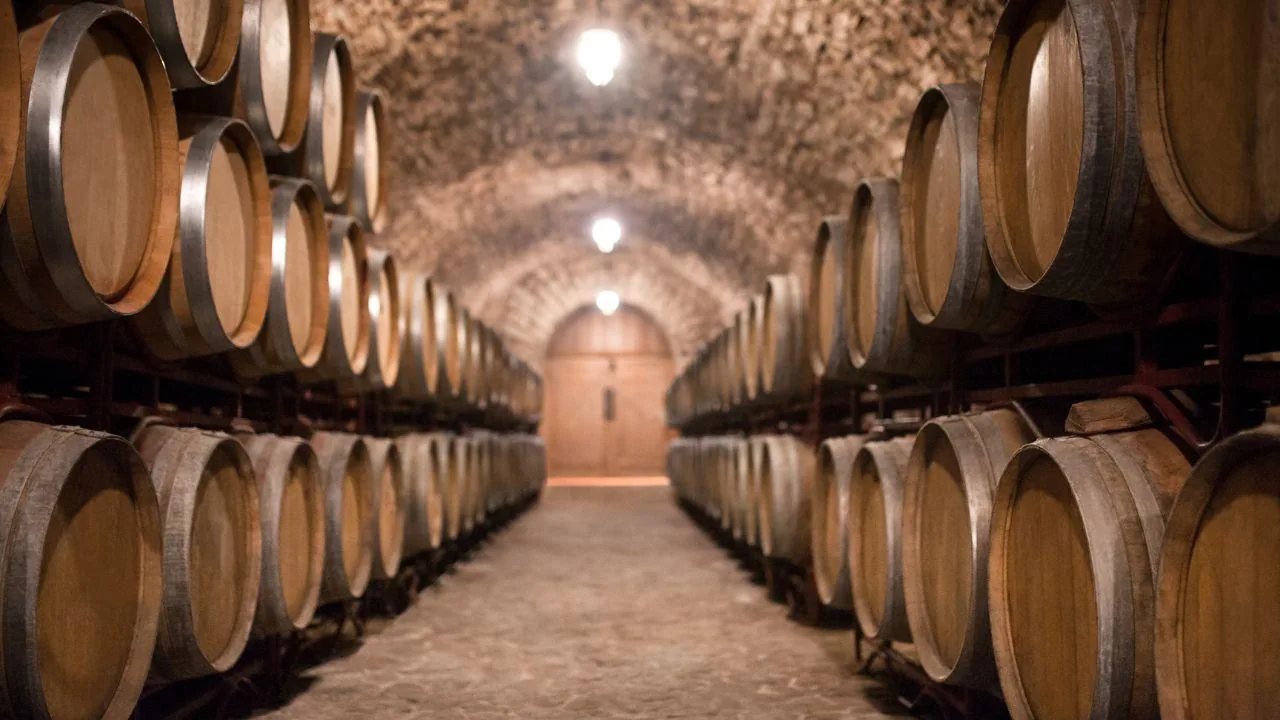
The numbers are ruthless: 5 million hectoliters of unsold wine in Tuscany, 59 million in Italy. Just to give an idea, this is equivalent to one harvest (regional and national). The wine sector is facing a severe overproduction crisis. And Tuscany is no exception.
Read more Wine crisis, Cinzia Merli: «There are no more happy islands, vision and unity are needed»
So, to clear stocks, one bottle out of five is “downgraded,” with bulk wine prices collapsing by up to 14.4% for common wines and declines also for Doc and Igp. Key data of the situation include record volumes – Tuscany is the third region in Italy for stocks, according to Cantina Italia data (the telematic portal and official public register of Masaf, Ministry of Agriculture, Food Sovereignty and Forests) with over 720 million potential bottles held -; downgrades and reduced prices.
Stop to new plantings
To curb the crisis, the Tuscany Region has slowed new plantings, limiting itself to small adjustments. The vineyard area in Tuscany exceeds 61,000 hectares, about 10% of the national total. Almost all of this heritage (95.7%) is destined for wines with Designation (Doc /Docg /Igp). Siena ranks first for vineyard area, followed by Florence with over 16,000 hectares cultivated; Grosseto follows with 8,500 hectares; Arezzo exceeds 6,200 hectares; in Livorno the coastal area (which includes the prestigious Bolgheri area and Elba) counts about 2,600 hectares.
The Cantina Italia map
According to Cantina Italia, stocks for 2025 are distributed as follows: 60.7% of wines are held in the North, Veneto leading, 54.6% of wine held as Dop, 26.5% as Igp, with varietal wines constituting just 1.7% of the total, and 17.3% represented by other wines. The top 20 Dop and Igp (out of a total of 526) account for 58.4% of stocks. Prosecco Doc alone accounts for 11.6% of Dop and Igp wine in cellars, with 5.03 million hectoliters, followed, with volumes over 1.5 million hectoliters, by Igp Puglia, Igp Toscana, Doc delle Venezie and Igp Terre Siciliane. Above one million hectoliters are Igp Veneto, Chianti Docg, Doc Sicilia and Igp Salento. Over 700,000 are Chianti Classico and Franciacorta.
Italian market: the data
- GDO sales (first 5 months 2026): -2%.
- Export (first quarter 2026): volumes: -4 ; value: -8.3%.
- Unsold wine: 53 million hectoliters (+7.3% compared to 2025)
(Source: UIV and Cantina Italia)
Sos from Frescobaldi
The stone is thrown by the president of the Italian Wine Union, Lamberto Frescobaldi. «Under current market conditions even a harvest of 44 million hectoliters is no longer sustainable – said Frescobaldi, who leads some of the world’s leading wine companies -. It is time to take responsibility for courageous choices even if unpopular, because immobility is already costing the sector much more than any rebalancing intervention. Overproduction is compressing value and profitability along the entire supply chain. Better a wrong decision than no decision at all».
An alarm that evokes plant shutdowns and “green harvest” (the destruction of unripe bunches), up to uprooting: the word – and the agricultural policy it represents – a great Italian taboo. In France, we are beyond that. But in our country, until now, there was talk of surgical reductions, yield decreases. All to avoid yielding to the drastic decision to take a step back. The SOS arrives in mid-July. With Uiv export data. Declining in traditional areas such as the USA, although encouraging signs come from new basins like Mercosur.
Tuscany market: the data
- Stocks in cellar: 5 million hectoliters.
- Downgraded wine: 1 bottle out of 5.
- Bulk wine price: collapses up to -14.4% for common wines and declines also for DOP and IGP.
Source Uiv and Cantina Italia
The word from the Consortia
But producers and Consortia urge caution. Says Stefano Campatelli, director of the Tuscany Wine Consortium (50 members – reaching over 1700 if considering the growers affiliated with cooperatives): «The Tuscany Wine Consortium in recent months has recorded a slight tendency to increase stocks. In June about 1% more than the same month in 2025. The increase in stocks is a consequence both of the overproduction recorded with the 2024 vintage and of a market trend that is suffering for many reasons and in particular due to many uncertainties at the international level». Read: tariffs, consumption decline, wars. «The Consortium – adds Campatelli – is working to offer producers greater commercial opportunities such as the possibility to produce Tuscany Sparkling Wines, which will be possible with the new Disciplinary from early 2027».
The Doc Maremma Toscana says it is ready to block new Vermentino plantings: «Cutting wine yields is not enough». The measure is under study from 2027. Says the president Francesco Mazzei: «We will not cut yields because long-term measures are needed such as a 1% block on authorizations and targeted uprootings».
Read more Ddl Ports, Ancip submits its amendments
FOR FURTHER INSIGHT

