






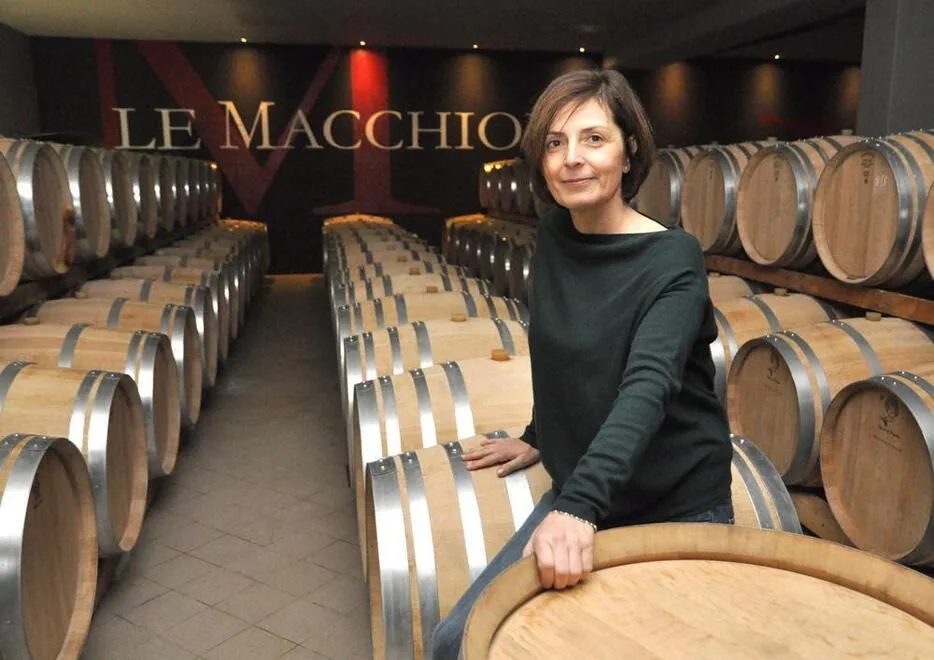
Cinzia Merli, the queen of Paleo, one of the most beloved Supertuscans, has been president of the Doc Bolgheri Consortium since 2025; she took over the baton from another top producer, Albiera Antinori. At the helm of Macchiole, Cinzia loves challenges, to be faced with grit and optimism. With her, we talk about the next big challenge related to overproduction.
Unsold wine stocks are a widely discussed topic. It is talked about especially after the last UIV assembly, where president Lamberto Frescobaldi stated that the current production level is no longer sustainable for the market, proposing drastic solutions including a temporary ban on new vineyards and a sharp reduction in production yields to avoid the collapse of prices for common and protected designation wines. What do you think about this?
«We are facing a moment of undeniable difficulty for the entire wine sector, which requires caution, utmost prudence, and a deep awareness. The situation is certainly complex and everything must be carefully monitored. The analysis by the Italian Wine Union touches on real points: we cannot pretend that consumption and market dynamics have not changed. It is time to manage production potential with intelligence and a long-term vision.»
Stocks amount, as of June, to 53 million hectoliters of wine, that is 10 million hectoliters more than the best harvests. An increase of 7.3% compared to 2025. According to Cantina Italia data, Tuscany is also on the podium, in third place. The most affected areas are those of Chianti, between Florence and Siena. How does Bolgheri experience this problem?
«The data on national and regional stocks require serious reflection from the entire supply chain. Bolgheri faces this phase with extreme caution and awareness because we know very well that we are not disconnected from the global context. For this reason, we must not lower our guard, constantly monitoring the situation, aware that protecting value and respecting the balance between supply and demand remain the absolute priority even for an excellent territory like ours.»
The problem concerns the entire wine world. France is addressing the issue with vineyard uprooting; the Paris government has allocated 130 million for a national program to reduce wine production. Italy is currently opposed to the uprooting hypothesis. You are the president of one of the most famous DOCs in Italy, how do you see the problem?
«Uprooting financed with public resources is an extreme measure, essentially an emergency intervention for territories facing a structural surplus no longer absorbable by the market. I understand Italy’s caution: destroying the viticultural and economic heritage is a step that risks impoverishing territories and landscapes. Rather than indiscriminately erasing vineyards, the priority could be to reorganize production and realign supply with real demand, focusing on sustainable quality rather than quantity.»
What do you think is the best solution? Or multiple solutions to integrate?
«More than a single recipe or top-down interventions, I believe we should talk about a shared working method. The sector is going through a transition phase and the answers can only come from constant dialogue between institutions, consortia, and category representatives. We must base ourselves on a careful analysis of market data, maintaining maximum flexibility to support companies. The priority remains defending the economic sustainability of our businesses, the centrality of quality, and the value of the Italian product in international markets.»
Can selective uprooting be considered in less suitable areas?
«This is a hypothesis that is part of a very broad and complex debate, where positions are many. At this moment, it is a priority to maintain sector cohesion and focus on broad actions for promotion and value retention. Structural choices on vineyard surface require time, data analysis, and balances that the supply chain will evaluate in due course.»
Read more Links, Italy-Tunisia agreement


