







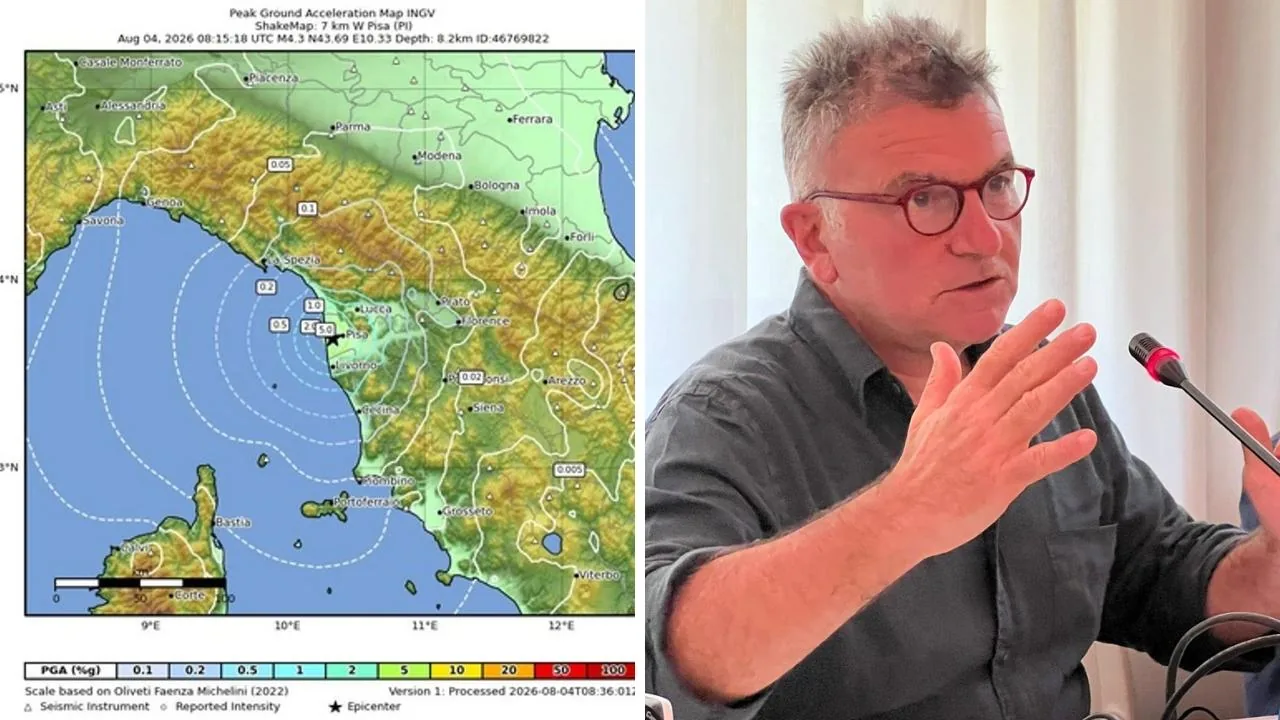
Half of Tuscany trembles at 10:15 on Tuesday, August 4. The National Institute of Geophysics and Volcanology (Ingv) detects a shock of magnitude 4.3, 7 kilometers west of Pisa, in the heart of the San Rossore Park, at a depth of 8.2 kilometers. It is the earthquake, the strongest recorded in the area in modern times, whose effects are also felt in Bologna and Modena; trains disrupted at the station under the Leaning Tower – a flurry of cancellations, average delays of 30 minutes, first signs of recovery a few minutes before 4 p.m. – and hundreds of reports received from half of Tuscany: “A very loud roar, then the shock.” The earth trembles again at 13:04. And it trembles again: ten shocks during the night between Tuesday, August 4 and Wednesday, August 5 with the strongest of magnitude 1.7 at 2:24.
- Earthquake in Tuscany, how geologist Gonnelli analyzes the phenomenon and how strong it really was: the explanation with numbers
The explanation from Ingv
Explains Gilberto Saccorotti, research manager at Ingv and seismologist. “In technical terms, this area is characterized by an extensional tectonic regime typical of the Apennine and peri-Apennine zones: the crust is subject to stretching which, when the rock resistance limit is exceeded, leads to a rupture phenomenon and therefore to the earthquake,” the expert prefaces, then adds: “The depth was moderate, typical of the Apennine areas. The distance of the city from the hypocenter was short, the aftershocks currently about ten. According to the Mercalli scale, still in use, which analyzes the effects felt by people, the intensity reported at the level of the municipality of Pisa was 4: vibrations of objects but not their fall.”
The fault systems of Tuscany
The seismicity of Tuscany is governed by two large fault systems: northern Apennines, extensional structures crossing Garfagnana, Lunigiana, Mugello and Val Tiberina; the transversal faults of the Apuan Alps, connected to the earthquakes of Lunigiana and the Massa-Carrara area; the coastal faults between Livorno and Pisa, located offshore.
Reactions and checks on the territory
President Eugenio Giani monitors the situation from Piazza dei Miracoli in coordination with the competent authorities, the Municipality, Civil Protection and the fire brigade. In Fucecchio, Livorno, Lucca, Massarosa, Montecatini Terme, Pescia, Pietrasanta, Pontedera, Prato, San Miniato, Florence and Viareggio the social media buzz is incessant. The municipality of the provincial capital of Livorno interrupts the ongoing council commission and triggers evacuation. In the walled city, a press conference is underway with regional councilor Leonardo Marras for the post-fire on Mount Faeta, here too everyone is out. In Pisa, people leave shops and pour into the streets, and in a few minutes the Ikea store also empties. In the territories where the shock was felt most, local administrations send their technicians to check the stability of infrastructures and more sensitive structures.
How Ingv monitoring works
Ingv has about six hundred stations positioned throughout the national territory, each equipped with seismometers and acquisition systems that then transmit signals in real time all to the seismic room in Rome where operators work 24 hours a day. When a certain number of instruments record a sustained variation in ground motion amplitude, a possible earthquake is reported, and by analyzing the arrival times of seismic waves, the hypocentral coordinates are then calculated. The first information is disseminated extremely quickly to allow the dispatch of any rescue. Then it assimilates further data, refines the first estimate and makes any revisions. “Which are often misinterpreted,” Saccorotti opens and closes parentheses again: “But it is simply an improvement in the accuracy of location and magnitude estimates, as happens in every measurement process.”
Read more Superenalotto, today’s winning numbers – Jackpot of 204.1 million euros
Similar events in the past
We ask him if it was a “record” event. “In this case we are not in the most seismic area of the region, but there are precedents of comparable magnitude: the Meloria earthquakes, a few kilometers west, in 2006 and before that (and especially) in 1984,” the expert replies.
Earthquake recurrence and prediction limits
“Earthquakes have a statistical recurrence: there are areas with greater or lesser seismic production, but return times can be very long compared to human times. Historical seismology helps us a lot in this, but unfortunately knowledge of past earthquakes depends on documentary sources that are only available in well-organized social structures. Another element is local geology, which can lead to amplification of vibrations. However, making predictions, like weather forecasts, in this field is not possible: a comparison with rain or river floods is not correct. Artificial intelligence can help us analyze the signal, but at the moment I doubt that the decades of experience of operators can be replaced by a machine.”
No link with climate change
Also off the table is the hypothesis of a link with the climate emergency. “Let’s say that science, to date, has not identified any cause-effect correlation.”
Are we ready for more shocks?
Are we ready for more shocks? “I repeat: we do monitoring and hazard assessment of seismic events. Tuscany has always been and continues to be at the forefront in seismic hazard assessments, and has carried out important programs of strengthening and consolidation of strategic buildings. Personal comment: investments in prevention should not be skimped on – concludes the expert – in purely economic terms, one euro in prevention saves seven in reconstruction.”