









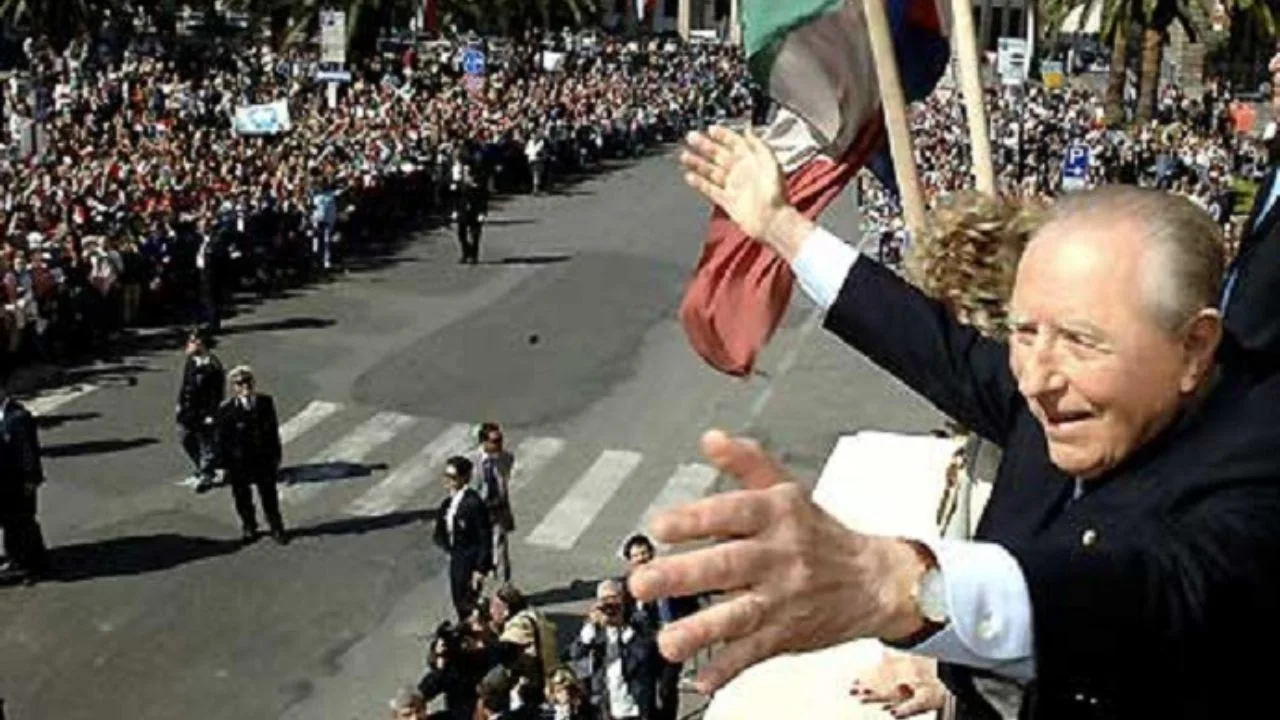
Ten years after his passing, the Ciampi Presidency remains an essential reference for cultivating the value of national unity, ensured by the Constitution and expressed by the very figure of the President of the Republic, which is essential for a healthy political opposition to then develop.
Carlo Azeglio Ciampi was elected President of the Republic on May 13, 1999, on the first ballot, with the vote of 707 out of 1010 electors.
At that time, he was certainly the most natural candidate for the Quirinale. In fact, the alternative candidacies, which had been discussed in the previous weeks, gathered only a few votes, despite being from authoritative political figures. Emma Bonino, who passed away a few days ago, had been supported by a strong media campaign called “Emma for President,” which certainly contributed to the success of the “Bonino List” in the European elections a few weeks later, but did not make an impact in Parliament.
No better fate befell even the most accredited candidacies of the Popular Party, which believed, given the presence of a Ds (D’Alema) member at Palazzo Chigi, that it could claim the Quirinale. In fact, Nicola Mancino, although favored by his position as President of the Senate, faced some resistance among the Ds, while Rosa Russo Jervolino, Minister of the Interior in the current Government, who, like Bonino, could have been the first woman at the Quirinale, was disliked by Berlusconi, who led the opposition, with whom the majority sought convergence.
This was easily found, precisely, in the name of Ciampi, who, although certainly linked to the center-left, being at that time Minister of the Treasury and Budget in the D’Alema I Government, was less politically exposed and therefore considered more capable of allowing a unified choice.
In fact, the votes of the center-left majority were joined by those of the center-right, with only the Northern League, Communist Refoundation, and some minor political forces remaining opposed.
Ciampi’s profile, as we said, was more institutional than political. Unlike all his predecessors and successors, in fact, he had never been elected to Parliament and had not been a party member. His career had been entirely within the Bank of Italy, until his appointment as Governor in 1979. The mandate, at the time without a fixed term, ended in 1993, when President of the Republic Oscar Luigi Scalfaro, faced with a political system totally discredited by “Tangentopoli,” appointed him as Prime Minister (the first non-parliamentarian in the history of the Republic) of a Government composed partly of politicians and partly of “technicians.”
After that experience, Ciampi seemed to have left the political scene again, but with the center-left victory in 1996, Prodi entrusted him with the role of Minister of the Treasury and Budget, also to lead Italy’s entry into the euro, which took place a few months before the election to the Quirinale.
The election on the first ballot (shared only with Cossiga), with a broad majority, places Ciampi among the Presidents elected as an expression of wide consensus (as happened several times, from De Nicola to Mattarella’s second term), rather than opposition (which also occurred on several other occasions: from Einaudi to the first terms of Napolitano and Mattarella) and therefore immediately able to express unity.
While it is true that some figures who rose to the Colle following broad parliamentary convergence later proved divisive (think of Cossiga), while others managed to unite (just think of Napolitano and Mattarella, re-elected with a much broader convergence), it is also true that a strongly shared election facilitates the President’s work as an interpreter of unitary demands.
It immediately places him above political parties, where the Constitution, of which he is the primary guarantor, also stands.
Ciampi succeeded very well in this role, despite having to coexist for five years with the Berlusconi Governments (II and III) after the first two years with center-left governments.
Certainly, there were moments of tension (from foreign policy, with the Iraq issue, to the broadcasting system, to the reform of the judicial system), but the great political stability of that period allowed Ciampi to be less involved in exercising the traditional powers of political mediation (appointment of the Prime Minister and early dissolution of the Chambers) and to devote himself more to consolidating the figure of the President as an expression of national unity and guarantor of the Constitution, also giving great importance to republican patriotism as a unifying element.
Ciampi, starting from the recovery of historical memory along a path that went from the Risorgimento to the Resistance, aimed to recover a shared memory, enhancing a patriotism that wants to highlight common belonging, sharing, and therefore expresses inclusion, within the framework of the Republic and Europe.
In this context, particular attention was also given to a new enhancement of symbols: from the Mameli Anthem to the restoration of June 2 as a public holiday to celebrate the Republic and with it the unchangeable values of our Constitution, democracy, equality, and solidarity, expressions of inclusion and opponents of selfishness, nationalism, and therefore war.
(* full professor of Constitutional Law at the University of Pisa)