


June 29, 1944. That day, that month, that year are engraved in the heart and tears of the people of Guardistallo. June 29, 1944: it is the date of one of the Nazi-fascist massacres that stained Tuscany with blood, and it still has no end.
The town is now one of the most beloved villages by tourists in the Val di Cecina, and over time it has unsuccessfully requested to be awarded the gold medal for civil valor for the victims of that horror: 52 civilians and 11 partisans rounded up in their homes, captured, piled up, and shot in the clearing of Bucaccia. Many books have been written about the Guardistallo massacre: Professor Paolo Pezzino from the University of Pisa published a text reconstructing the event, titled “Anatomy of a Massacre,” in which he tries to explain the peculiarity of that tragedy that goes beyond the tragedy itself: the division it created within the community of the town. Some of the inhabitants have not yet forgiven the actions of the partisans, which were followed by the massacre of the Nazis stationed in the village.
Now another piece comes to complete that tragic day 82 years ago. Among the victims of the massacre who have no “identity,” generally classified as non-residents, there is a 38-year-old woman: Maria Ceppatelli. After 82 years, her name has finally been reunited with a face and a story that deserves justice and remembrance.
The former mayor of Montescudaio and historian Aurelio Pellegrini, while rereading the documents of the massacre in which citizens of Montescudaio also died, came across Maria Ceppatelli. Nowhere did it appear that she was from Montescudaio, but from the registers of the Casa Giustri parish that name resurfaced. 38 years old, married since she was only twenty, without children, Maria lived in the Santa Maria farmstead in the hamlet that is now part of Fiorino, at the gates of Cecina.
And Maria was buried in Cecina.
Pellegrini says: “Her story was very private, the family never wanted to talk about what happened to Maria, they had her recognized by the priest of Casa Giustri, reassembled her body at home and then had it buried in the Cecina cemetery.” But how did Maria die? Thanks to the study of the documents and testimonies from distant descendants, her story was reconstructed. Pellegrini tells it. Maria Ceppatelli had learned that during the ongoing massacre in Guardistallo the Germans had also captured a relative of hers, perhaps a cousin: so she decided to go see what had happened.
In a burst of affection, she set out on foot along that road she had traveled many times: with her were also three men from Montescudaio, who had also heard about the massacre and wanted to check on their relatives.
Between Montescudaio and Guardistallo there are a few kilometers, but at the time there were no phones and communications were passed by word of mouth, carried by passersby.
When they reached halfway along the road, beyond the curve of the sports field, Maria and the others found two German trucks leaving the town and heading towards Montescudaio; from there, they were going to Cecina. The Allied troops were arriving and the Germans were retreating. Unfortunately for Maria and her travel companions, there was no escape: they were mowed down by gunfire. Their bodies were left under the sun, on the pavement.
But from the condition of Maria’s body, perhaps she was also subjected to violence. “There is no certainty about this,” says Pellegrini, “but it could be one of the reasons for the family’s great discretion.”
Several hours passed: Maria’s body was not recognized by the priest of Montescudaio, who had been called for the victims of his community, because she lived in the southernmost parish and was not known in the town, so more hours passed before the body was recognized by the parish priest of Casa Giustri and it was decided to bring the corpse home and reassemble it for burial.
“I also talked about it with Professor Pezzino,” says Aurelio Pellegrini, “nowhere, in any text about the massacre, is there any reference to Maria Ceppatelli’s story.” The discretion with which Maria’s family treated the case, the chaos that followed that horrible episode, the tumultuous days that followed the German retreat until the arrival of the Americans: all this contributed to leaving the story of a woman killed by the barbarity of war aside, buried in a corner.
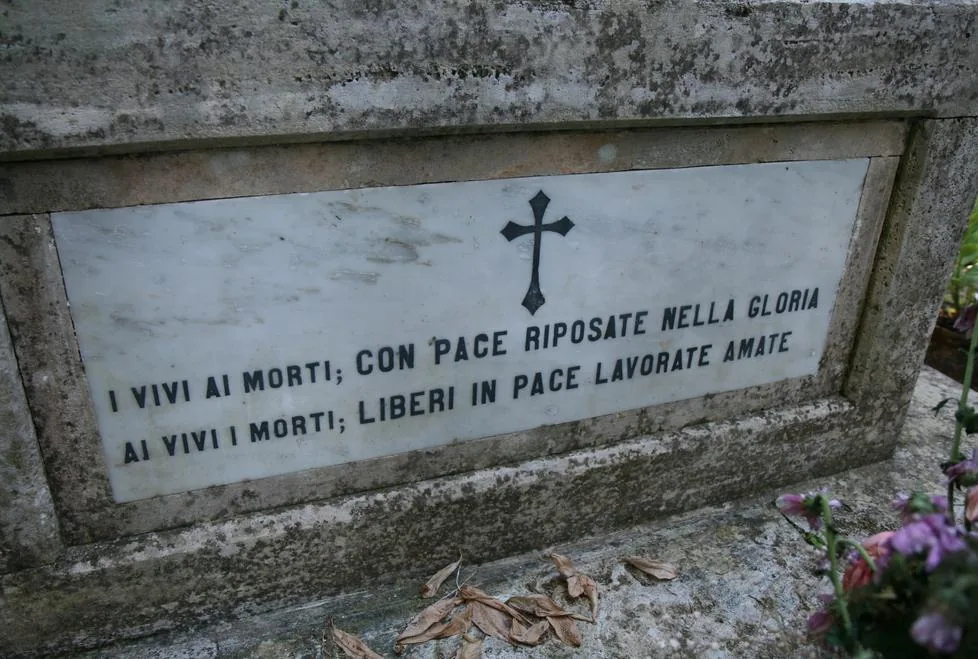
But now that her story has come to light, it deserves to be remembered. Aurelio Pellegrini asked the mayor of Cecina for help to find Maria’s grave and went to visit it: it is in a small oven-shaped tomb in the old part of the cemetery, not far from her husband. No reference to how she died. A small photo on the tombstone shows a still young woman, with dark hair and a simple face.
“I believe we must remember her story,” says Pellegrini, “placing it back in the rightful place: that of an innocent victim of a brutal massacre.”
The mayor of Guardistallo also verified: her name is included in the list of victims, cataloged among the non-residents, people who by misfortune were in the town and fell into the hands of the Nazi executioners.
After 82 years, the face of Maria Ceppatelli demands justice, that the truth of her story be recognized. Pellegrini asks that the Municipality of Montescudaio, where Maria was a resident, “recover more than 80 years of abandonment and erasure of memory, also giving Maria the honor she deserves, especially in the year in which we remember the achievement of full civil and political citizenship for women.”
There are four women victims of the massacre. Pellegrini adds: “The victims from Montescudaio are also four, Maria and three men. The men are remembered on the facade of the Town Hall and in the cemetery chapel, as well as every year at the June 29 commemorations at Bucaccia. Maria, however, is absent from everything, for 82 years she never existed, even though her name is engraved on the massacre plaques at Bucaccia and the Guardistallo town hall,” with the designation of “non-resident.” “Only we, her town, abandoned her,” Pellegrini adds, “we also erased her memory. Surely there are many mitigating circumstances, but the time has come to recover.”
© RESERVED REPRODUCTION
Read more There are limits to the use of images recorded by street cameras